Bishop Valero Residence, Low-Income Senior Residence Under Construction in Astoria, Queens

This summer, construction commenced on another low-income housing initiative in Queens, the likes of which have been in high demand in many parts of the New York City Metropolitan area. Unlike other affordable housing ventures, such as those CISLeads has covered like the Empire State Dairy and Archer Towers projects, Bishop Valero is one of the first to emerge since the start of the pandemic to focus chiefly on affordable housing for seniors. 

Bishop Valero is helmed by Catholic Charities Progress of Peoples Development Corporation and designed by Dattner Architects. The property located at 23-11 31st Road in Astoria, Queens, on the former site of the Catholic Charities Catherine Sheridan Senior Housing parking lot was meant to close in March of 2020. The COVID-19 shutdown delayed these plans in the earlier part of the year. Should another occur, its status should protect its continued progress as an affordable housing project.

Citing affordable housing as one of NYC’s enduring crises, Monsignor Alfred LoPinto, CEO of Catholic Charities Brooklyn and Queens stressed that the project would “provide much-needed housing to low-income seniors and a supportive environment for formerly homeless,” as “there are thousands of individuals in need of affordable housing in New York City, and we cannot build fast enough.”

What Are the Specifics of the Project?

The $62 million project has secured its funding from Bank of America, Barings, and Richman Housing Resources but also tax credits through the NYC Department of Housing Preservation and Development. Renderings show a six-story building with a plain tan masonry facade on the ground floor and brick-red cement on every floor above. The windows are asymmetrical on all the upper floors, giving it a slick, modern vibe. 

  • The residences will make up 102 units within the building, with one superintendent unit, comprising about 84,900 square feet in total, all on the upper floors.
  • The ground floor will house a 200-seat senior center, run by Catholic Charities Neighborhood Services. 
  • There will be daily, on-site prepared hot meals, referral services, educational seminars, fitness classes, and case management services in the senior center. 
  • 100 percent of all units will go to seniors making up to 60 percent of Area Median Income (AMI), with 30 percent of the units reserved for formerly homeless seniors with severe mental illnesses.

Rent subsidization will come through the U.S. Department of Housing and Urban Development’s Section 8 voucher program.

What Kind of Work Is the Bishop Valero Project Creating? 

Tradespersons and firms involved with the project can expect steady work through the next year, at the very least. Construction and ground breaking reportedly took place in early July. No demo has taken place or been scheduled. Along with the necessary wiring, plumbing, and structural work that goes into a building of this size, there will also likely be alterations to the area around, from sidewalks to any landscaping. The apartments themselves will likely include more than the standard residence by their need for accessibility. 

Currently, no timeline for completion is on record.
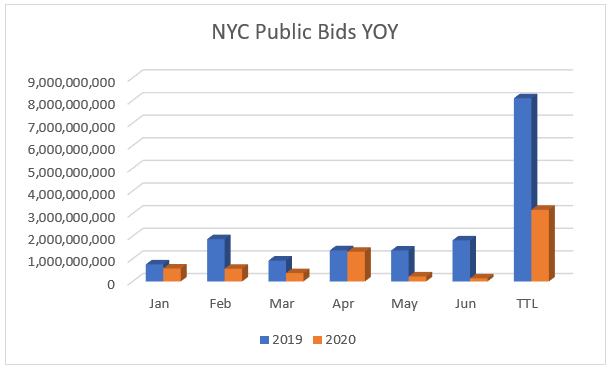
New York City Sees Biggest Negative Impact from Pandemic

The construction industry a took huge hit with coronavirus shutdowns and the ensuing economic downturn. But New York City was impacted more than the surrounding area in the first half of 2020, according to a CIS analysis of its projects.

In some of the most revealing numbers: new public projects put out to bid were down 51 percent. That’s more than 20 percent worse than Long Island and an even larger decline compared to Westchester, and New Jersey.

 Most discouraging was the total value of public projects that were bid in the first half of the year. Those numbers were down 61 percent. It is worth noting, however, that New York City’s project numbers were lower in January, February, and March, as well. The state didn’t shut down nonessential construction until March 31.

Employment in New York City building construction fell by more than 35 percent year-over-year in May, according to the state’s Department of Labor. While there was an immediate rush of activity and rehiring once non-essential construction could resume, that was primarily to catch-up on projects that were in progress. With the reduced number of public projects put out to bid, industry leaders worry that the work and hiring won’t continue.

Data from July backs that fear. According to the Associated General Contractors of America (AGC), construction employment in July was down 66 percent in 358 metro areas across the country compared to the year before. New York City lost the most construction jobs, down 26,500 (or 16 percent) from the previous July, according to the AGC.

Amid fears that the virus numbers will spike, forcing another shutdown in the city, contractors are pushing to finish work on projects in progress, but there is understandable concern that budget issues will kill any hopes of continued recovery. When the city’s budget passed in July – the first budget that has been lower than the previous year since the Great Recession in 2009 – money for affordable housing and public projects was cut. New York City faces a projected $9 billion revenue loss because of the global pandemic, at the same time President Trump is threatening to cut off federal funding to the city. If federal funding doesn’t come, Governor Andrew Cuomo says vital infrastructure projects and some of the city’s biggest construction plans, including projects at LaGuardia and JFK airports and the new Penn Station, could be put on hold. The AGC says that without federal funding, commercial construction companies will be forced to lay off more workers.

The analysis did show one bright spot: The number of new private projects being planned actually increased from 2019.

This could continue, particularly in private healthcare projects. Industry experts predict growth in healthcare construction for New York City over the next few years. There may even be an opportunity for private projects developing outdoor spaces for restaurants and retail.

New Hospital at CHOP King of Prussia Campus Making Progress

Progress continues on the new Children’s Hospital of Philadelphia building at CHOP’s campus at the Village at Valley Forge in King of Prussia, PA. In July, developers held a topping off event for the $186 million project and construction continues toward a late 2021 completion and opening of the 250,000 square foot, seven-floor inpatient hospital.

The new building sits alongside the existing CHOP specialty care and surgery center and will be the anchor of the Philadelphia hospital’s satellite campus. Plans call for 52 private rooms, and include an emergency department, a pediatric ICU, operating suites, and a radiology department.

This building is one of many in CHOP’s expansion into the Philadelphia suburbs in Pennsylvania and New Jersey. Ongoing and future projects include a specialty and urgent care center in Abington, PA, a medical office and retail center in Moorestown, NJ, and an inpatient tower in Philadelphia.

Progress on The Prime in Long Island City Steadily Continues

The Prime approaches another milestone as it marches toward completion. Since Circle F Capital acquired the property for development in 2016, the mixed-use project at 22-43 Jackson Avenue in the neighborhood of Hunters Point has been gradually taking shape for years now, and the project remains about a year from coming to an end. 

Featuring condominiums for sale on the upper floors and commercial space on the ground, the Prime’s slower stretch to the finish line can at least partly be attributed to the shutdown of construction in the early months of the COVID-19 outbreak, where all residential construction, aside from those deemed essential, was shut down. Other mixed-use projects in Long Island City managed to bypass this because their plans included affordable housing. 

Recent visits to the Prime have shown that the exterior details such as guardrails and the facades, which were still in progress a year ago, are taking their final forms. 

The Prime: The Project at a Glance

Circle F Capital’s initial plans for the Prime revealed a structure reaching eleven stories above ground, hugging the obtuse-angled intersection of 46th and Jackson Avenue. The first images revealed in 2017 showed SRA Architecture + Engineering’s designs for a mixture of light-colored masonry and tall, protruding walls of windows, and the developments since have shown little has changed. 

Once finished, the Prime will feature at least 71 residences averaging 900 square feet, ranging from one to three-bedrooms, and are being marketed starting at $675,000. The total square footage for the residences is a little under 64,000 square feet.

The ground floors will feature over 11,000 square feet of commercial space, and with the Court Square subway station across the street and the 23rd Street station just blocks away, this would mean easy transit for shoppers and residents alike. 

Most reports suggest the finished structure will amount to 120,000 square feet of space. Eastern Consolidated suggests new residents can expect centers for business and fitness, a children’s playroom, outdoor spaces, and bicycle storage, but is the only source to claim this. 

One can only assume more information is forthcoming, but at present, even the Prime’s main website remains cryptic. 

What Remains to be Completed on the Prime at 22-43 Jackson Avenue?

Exterior photos of the Prime show that most of the windows and outer masonry have been installed, with the dotted lines of rail-less balconies delineating each of the floors. A large area of the open wall remains where a hoist once stood. No longer needed, this gap is gradually being filled in. 

The area that seems to be the furthest from completion is the mechanical section on the roof, which still shows signs of waterproofing in progress. No information about how far along interior construction and design happens to be, though the interior designer has been confirmed to be Andres Escobar.

Initial reports on the property in the early part of its development projected a 2020 completion date. Right now, brokers and buyers can expect construction to wrap up sometime in 2021. 

Mixed-Use Building Gets Approval for Newark’s Ironbound District

A new mixed-use building has been approved by the Newark Planning Board. Florio Residential and Retail at 648-652 Raymond Boulevard calls for 120 residential units and 2,800 square feet of ground floor retail space. It is another building in the ongoing redevelopment of Newark’s Ironbound District in the East Ward.

The new five-story building across from Newark’s Riverfront Park will be more than 141,000 square feet. The residential floors will be a mix of studios and one- and two-bedroom units. There will also be more than 1,200 square feet of amenity space on the second floor and a 5,200 square feet terrace for use by residents.

A ground level parking garage with 89 spots is also planned.

The project requires the demolition of the existing building on the site, which sits a little more than a mile from both Newark Penn Station and the PATH station in Harrison.

Steiner Studios to Bring Massive Production Hub to Made in New York Campus in Sunset Park

Another portion of the old Bush Terminal complex is slated to become the site of another major transformation in the ongoing Made In New York campus project. Steiner Studios, known to manage multiple Brooklyn Navy Yard sound-stages, will be constructing an enormous TV production hub, projected to comprise around 500,000 square feet of space. It will bring over 2000 new jobs to the area and that’s excluding the work the construction, itself, will bring over the next couple years. 

The collaboration with Dattner Architects will take place in one of the remaining parts of Bush Terminal where the city has retained ownership once the Made in NY Campus initiative went into motion in 2017. It follows a continuing trend as more movie and television studios begin to move operations to the New York area, with past examples including Lionsgate, who announced a New York base in 2019. 

The Made in New York Campus, at a Glance

Expected to remain under construction until 2021, the Made in NY Campus is in itself an enormous undertaking and has been since plans for it were unveiled several years ago. Its aim: to create a focal point for local manufacturers. Bush Terminal, already a center for industry and home to multiple garment manufacturing plants, has grown increasingly derelict through the decades, with many proposals for renovation and redevelopment coming to very little. 

The Made in New York campus, once completed, will provide a new center for garment manufacturers outside of New York’s Garment District, as well as additional soundstages for television and film production. Its original proposal involved renovating two historic buildings and a 200,000 square foot building called the Hub, which will be fitted to serve between twenty and thirty tenants specializing in sample production, pattern making, and cutting and sewing. 

The Steiner Studios project, an addition to these already existing plans, will take up a space much larger than the Hub. 

The Full Details: What Will the Steiner Studios Project Involve? 

Steiner Studios will be personally investing $320 million into the new complex and also extending their efforts to other parts of the surrounding area, including completing construction on the nearby Bush Terminal Piers park and contributing $25,000 every year to park programming. They also expect to contribute to local hiring, job training, and workforce initiatives at local high schools, the surrounding community, and nonprofits that promote diversity and inclusion in television and media. Their 500,000 square foot studio space will include: 

  • Eight soundstages.
  • Two historical buildings to be fully renovated and serve as production support. 
  • A six-story parking structure.
  • Exclusive loading docks.

Along with an expected 2,200 new full-time jobs once the structures are finished, as many as 1,800 temporary positions are forthcoming for laborers and construction workers. The work entailed will They are expecting a 25 percent participation rate through Minority and Women-Owned Business Enterprises. They will be required to recruit from the local community through HireNYC. 

Steiner Studios is presently expecting a 2022 completion date.

New Townhouses Planned for Asbury Park Waterfront Redevelopment Area

Asbury Park is adding more luxury residences, as the NJ Shore city’s planning board approved the application for preliminary and final site plan and major subdivision for the AP Triangle Townhouse Development earlier this month.

The approximately four-acre, triangular space bordered by Heck Street, Cookman Avenue, and Asbury Avenue is part of Asbury Park’s Waterfront Redevelopment Area, which covers more than 140 acres. The 24-lot site will be subdivided into five lots. Residential buildings will be constructed on three of the lots. A fourth, on the northeast corner of Heck and Cookman, will be an outdoor public space. The fifth lot will remain undeveloped.

The new construction will create 48 townhouses with at least three bedrooms and three baths and include a loft space and roof deck. Plans also call for each unit to have two parking spaces, one in a garage and another in the driveway.

Long Island City Mixed-Use Project Completes Foundation, Progresses

On a busy corner of Jackson Ave in Long Island City, the latest from KSQ Architects and the Vorea Group shows signs of life and hopes to begin to emerge above-ground. Jackson Square has been in development since at least 2016, with plenty of time since then to evolve. It is one of many mixed-use projects that has managed to continue steady development in the Long Island area. 

However, unlike other local mixed-use ventures like Lighthouse Point, Jackson Square will not include permanent housing, much less affordable housing, which has been a major sticking point for keeping certain construction projects open during the pandemic. It has nonetheless continued to progress in the last few months, with foundation work beginning in April and drawing to a close in August. 

The Project: How Has Jackson Square Evolved? 

The first whisper of this project began in 2016 when the Vorea Group purchased a 99-year lease for the property, a mere 10,000 square feet prior to development, with initial images showing a simple corner retail space rising to towering heights of…a single story.

The location sits a single block away from Court Square Subway Station, with access to the G and 7 trains, and immediate plans appear to center around making the most of that. 

From the very beginning, proposals involved at least 50,000 square feet of new construction, including retail space, offices, and a hotel. Commuters looking to shop, work, or stay over would have immediate access to the city’s transit system. 2016 reports projected 30,000 square feet dedicated to retail on the ground floor, with no immediate information on the division between office space and hotel space.

It would take another two years before the demolition permits would be filed, the rest a year later in 2019. At this time, it projected that the finished project would be nearly 150 feet tall, and estimated around 67,000 square feet of space, including speculations on rental units. 

In the time since, at least two renderings of the space have been released to the public, both wildly different. The earlier ones featured a gray steel and concrete-based facade, and the latest features a more classical dark red exterior. By the time of the first rendering releases in October 2019, the plans then specified ground floor and cellar retail space, offices on two floors, and a 72-unit hotel on the remaining six floors, totaling nine above-ground floors.

As of April 2020, when foundation work began, the final plans promise a structure with over 87,000 square feet of space. 

Almost 20 Years Later: Construction Resumes on Church Destroyed in 9/11

Numerous historical projects have resumed work in recent weeks, including advances at Rockefeller Plaza. However, this recent news brings to mind historical events that still weigh heavily in the minds of many New Yorkers. September 11th, 2021, it will mark exactly two decades since the 9/11 attacks that took nearly 3,000 American lives and completely changed the shape of the nation forever. 

However, this somber occasion is now also slated to be marked for something happier and more hopeful: the long-awaited completion of the St. Nicholas Greek Orthodox Church and National Shrine. Recognized as the only house of worship to be destroyed in the attacks, efforts to rebuild it have taken nearly 20 years to come this far. Last week, construction resumed on the halfway-finished structure after two years of delays. 

What Has Been the Timeline on St Nicholas’ Church’s Rebuild?

Plans to rebuild the once-devastated structure were almost immediate. Immediately, millions in donations poured in, along with promises of construction materials, all coming from individual donors and the Ecumenical Patriarchate, the Greek Government, and the city of Bari, Italy. Plans to include it as part of the new World Trade Center complex also appeared as early as 2003, according to the first volume of Greek Orthodox Parishes of New York State – a Photo Tour.

Land was chosen in 2008, which would move the church from its original location on Cedar Street, where it stood for over 100 years. Its new location is at 130 Liberty Street, just south of the 9/11 memorial. Debates between the Port Authority of New York and New Jersey and the Archdiocese would continue until 2014, with Santiago Calatrava attached to design it. The Spanish architect took inspiration from Byzantine holy places such as the Hagia Sophia.

The cornerstone was laid on October 18, 2014, and the structure topped out in 2016. This timeline is fraught with frequent delays due to funding, with construction shutting down for the hopefully final time in 2018. 

St. Nicholas Church: What Remains

When construction resumed in recent weeks, sources suggested the structure was halfway done. Cranes have moved onto the site to begin installing the skylights in the main dome—much of the new design centers around light, both what comes in and what it emits. Situated 25 feet above sea level, the church will sit above the oak trees in the Memorial Park and is designed to glow at night. 

Sources have been markedly close-lipped about any details regarding what remains to be finished, beyond what can be seen in current photos. A largely stone structure, much of the outer facade has yet to be finalized, with containment scaffolding obscuring much of its unfinished face. 

The projected 2021 completion date speaks to the work that needs to be done. Finishing the masonry for the outer structure, with the likely need for attention paid to interior details, glass work, utility installation, and more, promises to be a busy year for the firms involved in St. Nicholas’ reconstruction. 

Bridesburg Waterfront Park Gets Grant To Move Forward

Plans for a 10-acre waterfront park in the Bridesburg section of Philadelphia are moving forward after PennDOT awarded a $1.4 million grant to the city last month.

Construction of Phase 1 is expected to begin in 2021―with a public opening set in 2022―at the site in the historic neighborhood along the Delaware River. Phase 1 includes a large lawn area, restrooms, parking and walking trails.

Phase 2 will be the construction of stage and picnic pavilions, terraced lawn seating, and a river boardwalk. The park will connect to an existing 2.2-mile trail and create an 11-mile stretch of parks and trails along the Delaware River. It will be part of the Circuit Trails and East Coast Greenway networks that run 750 miles and 3,300 miles, respectively.

Additional funding for the $9-million waterfront project, being built on the site of a former concrete plant, is being procured by Riverfront North Partnership and the city of Philadelphia.

In a second, related project, a new two-lane road with a dedicated bike path will be built to ease traffic in Bridesburg and offer more recreational opportunities for bicyclists and pedestrians.